

How To Quantize Audio In Logic
If your rhythms are off, no fear!
Whether it's for midi or sound files, quantization is an important tool to ensure everything is locked in with your tempo and grooving.
Permit'south start get on the same page about what quantization is and what does its hateful for united states of america music producers. After that, let's go through how to quantize midi and how to quantize audio because both have a very dissimilar quantization process. As always, if you'd adopt to learn how to quantize in logic pro by watching a video instead, then you tin can practice so hither .
What Is Music Quantization?
If nosotros await at the definition of music quantization and so nosotros get this:
In digital music processing technology, quantization is the studio-software process of transforming performed musical notes , which may have some imprecision due to expressive performance, to an underlying musical representation that eliminates the imprecision. The process results in notes being set up on beats and on exact fractions of beats.
Does anyone larn from these standard definitions though?

Not me.
Let's intermission information technology downwardly into very unproblematic English language:
Quantization puts our music in time with the assist of a computer.
Earlier we introduced computers into the procedure of making music, there was no such thing as quantization. When Bach and Mozart were composing global masterpieces they never had quantization. The concept of quantization might literally blow their minds!

Still, most music in the modernistic world is equanimous and created on a estimator. Of course, a lot of music is still recorded, still, we can yet quantize our recordings too! This allows us to be much more productive and to apply digital processes like quantization.
So, at present we know that quantization is when a computer helps u.s.a. put our music in fourth dimension.
Let's effigy out how it actually does this.
How Does Quantization Work?
Quantization is a digital process that is capable in nearly every professional digital audio workstation. In this post, we'll exist showcasing quantization within Logic Pro. However, it's of import to empathize that it is available in virtually every DAW. For example, Pro Tools, CueBase, FL Studio, Ableton, even GarageBand has quantization and that'due south a free DAW!
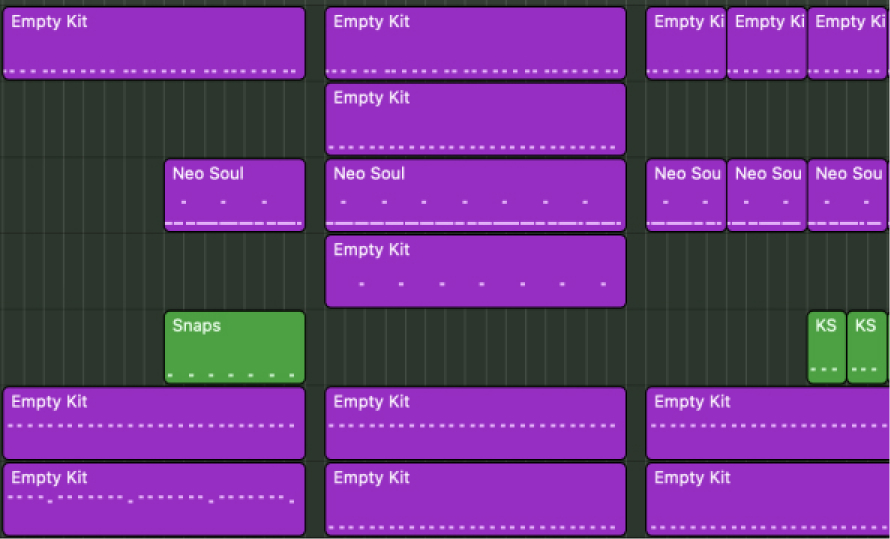
Quantization works within a filigree format. If you have experience working with a DAW then y'all'll know what "the grid" is.
Essentially the grid represents bars of music. I don't want to go too theoretical in this post but it's important to empathize a very tiny bit of musical theory if you lot desire to know how quantization works.
In music, nosotros take confined of music that brand up a vocal. Inside a bar of music, you would typically have 4 beats. There is a diverseness of time signatures in music that could have more beats or less beats within a bar of music. Notwithstanding, we're going to briefly hash out the standard structure of music which has four beats within 1 bar of music.
Ok, and then 4 beats. i bar. Recall that. Here's an paradigm below that will aid you visualize confined and beats of music within the grid of Logic Pro.

Now that you accept an understanding of bars and beats of music within the grid of Logic Pro. You'll be able to quickly grasp quantization. Let'southward assume yous play a slice of music. Whether that is on midi or audio. Information technology doesn't' thing right at present, we'll get more than into this after. Allow's say you tape a midi synthusing a software instrument in Logic.
You do your best job recording the midi synth to your project tempo. Let'southward say your project tempo is 114 bpm.
This is very important because the grid in Logic works off of your project tempo. If you have started recording without a projection tempo and then be sure to stop and cull a tempo first. This is an essential step. If you're unsure about what the tempo is of your song, you can check out this short video here .
Allow's assume you lot finish your recording and you decided yous'd like to use quantization. Therefore, yous engaged the quantization algorithm. Logic now works its magic and will await at your recording and start to motion the notes of your recording to place it "in time" with the tempo of your vocal.
But how does information technology know what is "in time" vs what is "not in time?"
Bang-up question.
It knows because you tell it a value to quantize too. We will get into these values below. Permit's know suspension up quantization into midi and audio. MIDI would exist recording whatever software instruments in Logic Pro and sound would be recording something like recording vocals or recording guitar.
Quantizing MIDI
We Demand To Record MIDI First
You can record midi with a midi keyboard or open the keyboard with the key command "command K", as shown below.

Select the software instrument rails yous desire to record and printing "R" to record. I personally like to tape with my midi keyboard. I apply the Arturia KeyLab 49 . One of my favourite software instruments to showtime out with and go ideas in Logic Pro is either the Yamaha Grand or the Deluxe Modern electric piano. Once you've finished recording your MIDI, we're set to quantize.
Step i:
D ouble click on your midi region to open up the midi editor or printing "Due east".
Step 2:
Select all the midi notes by dragging over all of them to highlight them or select the first midi annotation and use the quick key "shift F" (select all following). Another option is to simply use the shortcut command: "cmd+A" which will select all the midi notes. We accept options.
Pace 3:
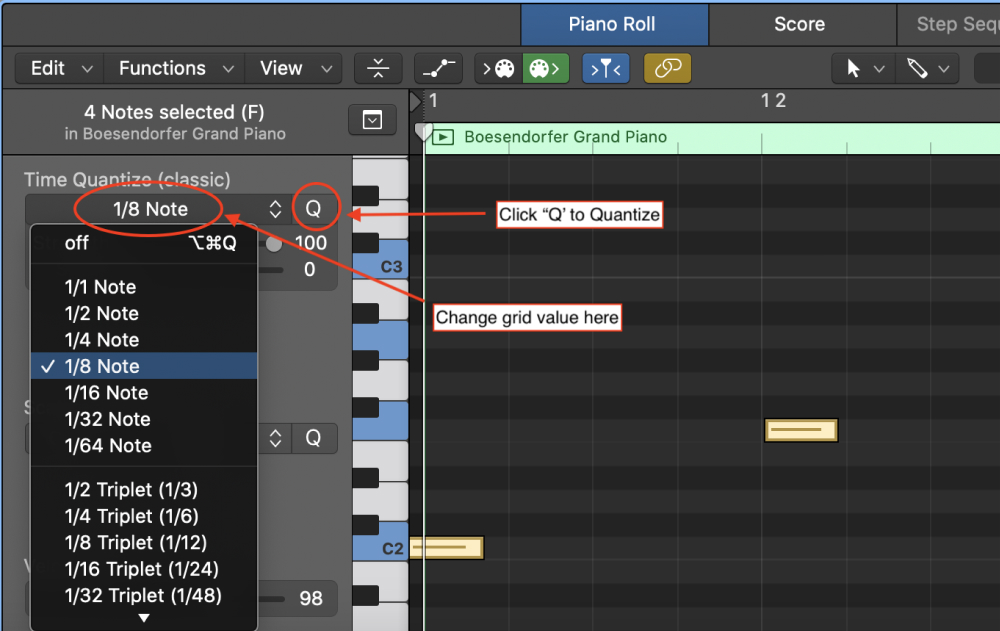
Recollect when I mentioned that we tell Logic Pro a value to quantize likewise? Well, that's what we're going to do in this pace. Look on the left side of Logic Pro, on the time quantize panel, select the fourth dimension grid you'd like to quantize too.
Non Sure What Value To Choose?
You're not alone.
This is a mutual trouble for beginners considering they are unfamiliar with the note values. It's actually much more simple than you might retrieve. Remember when I was talking about bars and beats in the beginning section? So the value i/1Note is a whole crush. The value 1/2 Annotation is half a vanquish. That's information technology.
Basically, Logic is request you:
"what beat should we move the notes too?"
And you need to tell Logic, "delight move the notes to the nearest 1/four Note" or "please move the notes to the nearest 1/16 notation".
A adept dominion of thumb is besides kickoff by choosing ane/16 Note. If your original recording is fairly "in fourth dimension" then this volition accommodate the notes to the proper timing. If this did not work, try doing downwardly to 1/eight Notation. When in doubt, you tin ever choose "off" and this will prepare your notes dorsum to their original position.
Don't worry. Y'all can always go back to square one.
Quantize Strength
You can conform the strength of the quantization by clicking and dragging on the slide bar titled "strength".
For a more man performance, set it to fourscore or ninety rather than 100. However, this will also depend on your original operation.
Y'all tin can think of the slider every bit being a percentage slider. For example, if you lot set it at 80% that means that information technology is going to include 20% of your performance and then fourscore% of the quantization algorithm. The quantize force meter will depend on how you'd similar your music to sound. Practice you want is super quantized and on grid? This sometimes is a necessity in certain parts of the vocal or even in some genres of music like EDM. Take a listen to the piano in a lot of Avicii manner songs , practice y'all think he quantized the piano? Aye, 100000% he did!

Quantizing Audio
If you're unfamiliar with how to tape audio in Logic Pro then be sure to check out my posts on how to record guitar and and how to record vocals in Logic . I also beloved reversing audio as a cool production play a joke on in my music, if you're interested, I tin teach you how to reverse sound in Logic besides .
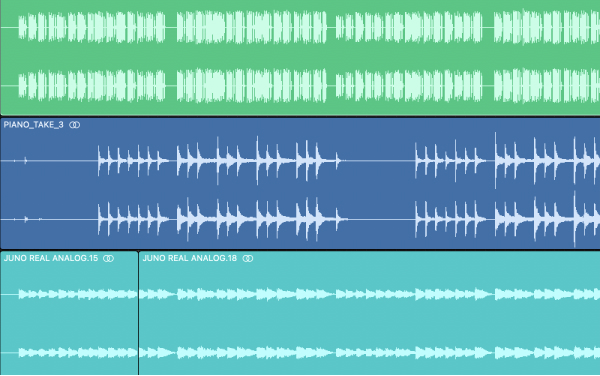
Quantizing audio is quite different than quantizing midi. They have very different quantize algorithms considering it's working with two very different pieces of date: MIDI and Audio.
Unforunately, audio is much less flexible than MIDI. For instance, you lot tin can only stretch and move a piece of audio so far until it starts to audio bad.
Not to fright!
Quantizing sound is nonetheless possible. However, the improve your initial performance and recording of the audio, the easier it will be to quantize your audio.
Quantizing sound is different from flex fourth dimension or smart tempo. It does non affect the information within each region, it simply affects the position of the region. For example, if you have a agglomeration of spliced regions, quantizing those regions will motion their start to the nearest grid.
In Logic, at that place'south an unassigned key command that could be helpful for quantizing audio. Open up up the key commands manually by using the key command "option K" and type in the search bar "slice at transient markers".
Assign your own command past typing it in the box next to where it says "central".

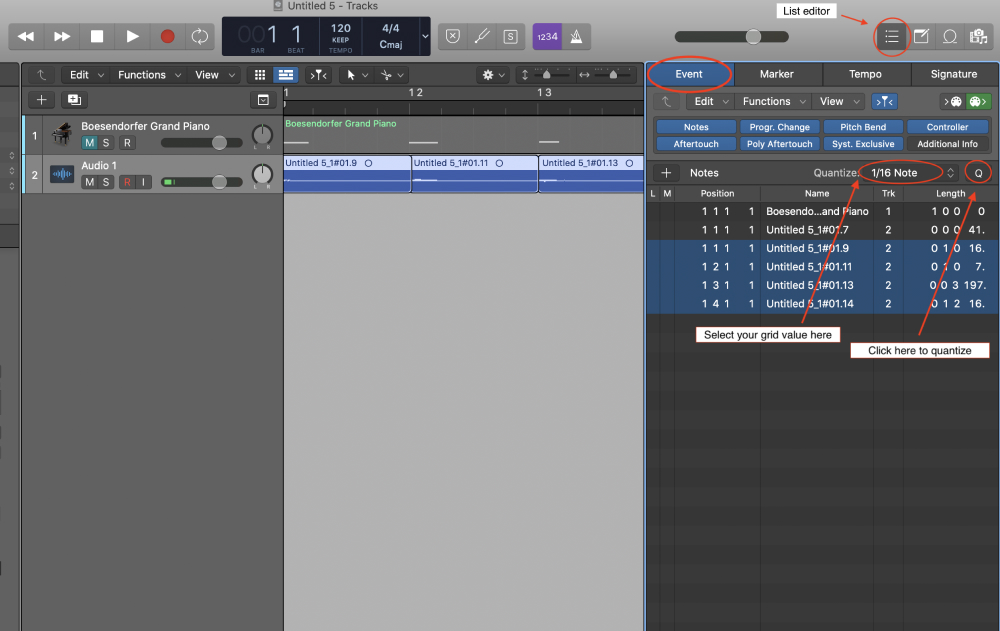
One time y'all accept all your sliced regions, open up upwards the list editor by clicking on the icon in the top right or using the quick central "D".
Click on "event". Select all the regions you desire to quantize. Select your grid value adjacent to where it says "Quantize" and click on the "Q" button, as shown beneath. Call back the grid note vales we had when we were quantizing midi? These are the verbal same values. We're just doing it for sound instead.
Brand sure to mind back to your quantized audio to make sure it sounds as yous'd similar to. For example, sometimes when I quantize audio, I realize I chose the wrong note value. So, I'll go back and change it to 1/4 Note or ane/8 Note to encounter if that fits better. Call up, you lot tin can always adjust the note values. You accept room for error.
Has Quantization Ruined Music?
I always think the advocacy and change in a particular expanse, similar music, is e'er a good thing. It pushes the industry forward. Without whatever blazon of change, the songs would always remain the same and that's dull!
There will e'er be negative and pessimistic naysayers when it comes to quantization or making music on a computer, in general. I no non call back quantization has ruined music. However, I practise think that it has opened upwards a new challenge within the music globe. It'due south so like shooting fish in a barrel to make music nowadays! This means that the level of supply of music but increased dramatically over the terminal decade or and so. Usually an increase in supply means a subtract in quality.

Now, how has this all stemmed from quantization? Well, information technology's not all coming from just "quantization". We shouldn't be so mean to Ms. Quantization. It's only a small attribute of the different techniques we tin use in the modern world to brand music very quickly. Another technique would be non recording anything and learning how to chop samples and quantizing these samples to brand music. You could even go so far as automating quantizing in Logic too. When information technology comes to making music with a computer, the opportunities are endless.

I e'er say, it doesn't matter how you make music. It matters how you feel listening to it. I don't care if I'm listening to a robot that has quantized 1/8 Note values of beeps and bops. If it makes me feel something, then I like it. If you'd like to learn more about quantization and music production within Logic Pro then I advise y'all get my complimentary 6 pillars on learning Logic Pro faster.
Source: https://www.charlescleyn.com/blog/how-to-quantize-in-logic-pro
0 Response to "How To Quantize Audio In Logic"
Post a Comment